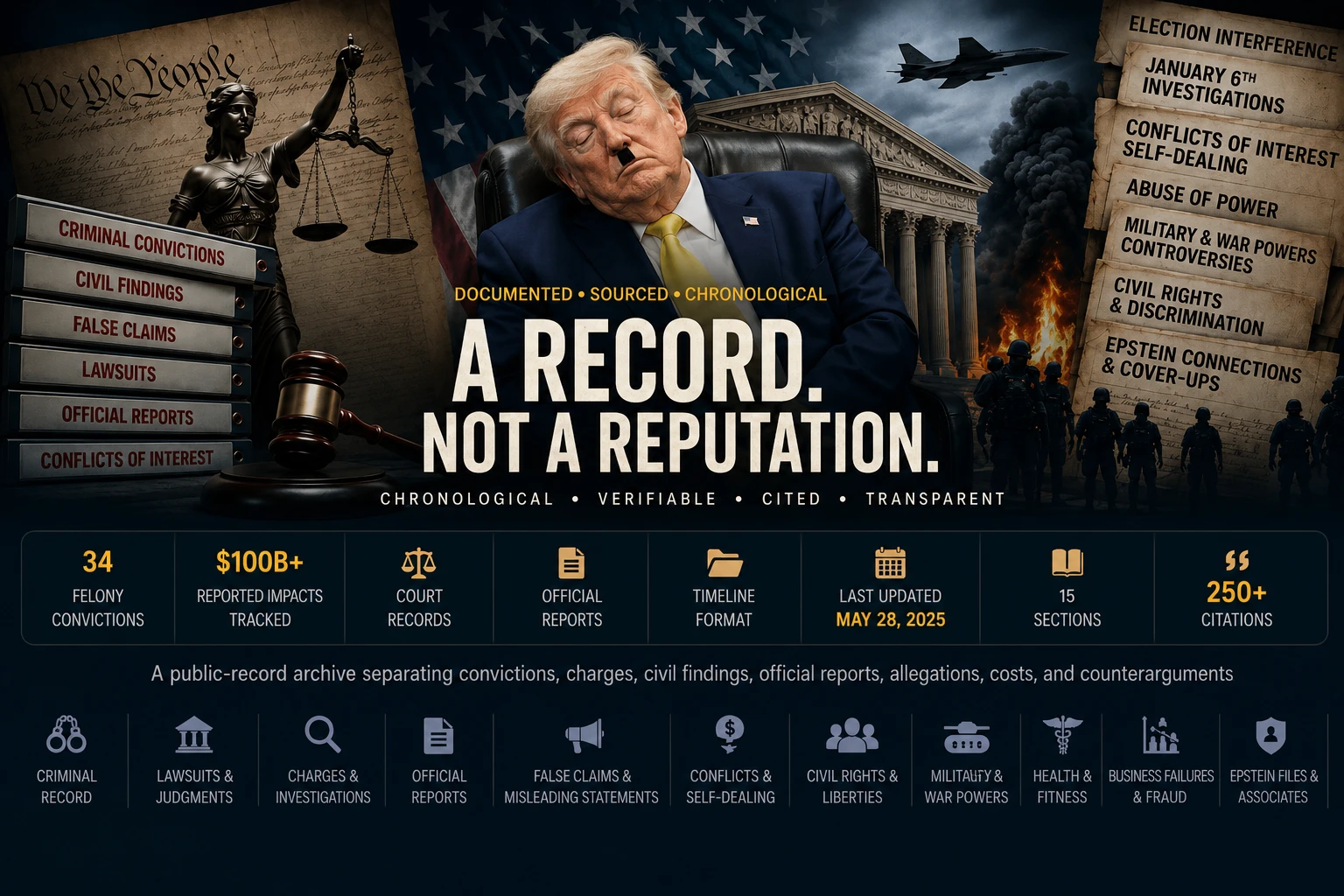
Overview and scope
This page is organized as an evidence index. Each section distinguishes proven court outcomes from allegations, official records, watchdog findings, reporting, legal commentary, and political criticism. It is designed for readers searching for sourced information on Donald Trump’s criminal record, civil cases, conflicts of interest, false or misleading claims, civil-rights policies, military actions, and related controversies.
Search this archive
Fully local browser search. Search stats stay in this browser only via localStorage; nothing is sent to a server.
archiveSearchStats. No cookies, no third-party scripts, no endpoint, no database.Table of contents
- Overview and scope
- Crimes adjudicated in criminal court
- Criminal charges that were filed but not proven by conviction
- Related civil findings, not criminal convictions
- Documented false or misleading claims while in office
- Documented self-dealing, conflicts, and profit-from-office schemes
- Documented civil-rights, civil-liberties, racial-justice, public-aid, and anti-hate concerns
- Potential war-crimes, international-humanitarian-law, and accountability controversies
- Documented efforts to discredit critics, influence public perception, and challenge independent institutions
- Additional documented categories: quid pro quo, litigation as pressure, Epstein references, sexual-misconduct allegations, and pro-Israel donor / influence networks
- Observable health issues, medical disclosures, and 25th Amendment / impeachment calls
- Documented Personal and Business Failures / Major Setbacks
- Additional use-of-force legality issues and dollar amounts
- CENTCOM, Iran-war transparency, base damage, casualties, preparedness, and dissenting military/national-security voices
- Scientific speech, biomedical research, and public-health censorship controversies
- Bottom line
Felony counts of falsifying business records in the first degree, found by a New York jury on May 30, 2024.
Federal prosecutions brought by Special Counsel Jack Smith were later dropped or dismissed before trial.
Major civil findings include sexual abuse/defamation liability and New York civil fraud findings. These are not criminal convictions.
Crimes adjudicated in criminal court
New York: falsifying business records in the first degree
Convicted
- Counts: 34 felony counts.
- Verdict date: May 30, 2024.
- Core conduct: prosecutors said Trump caused business records to be falsified to hide damaging information during the 2016 election cycle.
- Sources: Manhattan District Attorney announcement; New York court decision denying dismissal/vacatur.
Manhattan DA: 34-count felony trial conviction · NY Courts: People v. Donald J. Trump decision/order
Criminal charges that were filed but not proven by conviction
| Case | Status | Charges / allegations | Sources |
|---|---|---|---|
| Federal 2020 election case | Dropped before trial | Trump was indicted on allegations related to attempts to overturn the 2020 election. The case was dismissed/dropped after prosecutors moved to end it following the 2024 election. | DOJ indictment PDF · Reuters status report |
| Federal classified-documents case | Dismissed / appeal dropped | Trump was charged over retention of classified documents and obstruction-related allegations. The case was dismissed by the district court; the appeal as to Trump was dropped. | Reuters: appeal dismissed · ABC News: prosecution ended |
| Georgia election-interference case | Dismissed before trial | Trump and others were indicted in Fulton County, Georgia, on racketeering and election-interference-related charges. The case did not result in a conviction. | PBS: Georgia indictment · Georgia Recorder: dismissal |
Related civil findings, not criminal convictions
E. Jean Carroll civil cases
Civil liability
A jury found Trump civilly liable for sexual abuse and defamation in 2023, with a $5 million verdict that was later upheld on appeal. A separate jury awarded Carroll $83.3 million for defamation in 2024.
Reuters: $5M verdict upheld · Washington Post: $83.3M judgment appeal
New York civil fraud case
Civil liability
New York’s attorney general won a civil fraud ruling against Trump and related defendants in 2024. An appellate court later vacated the large monetary penalty while leaving parts of the civil findings/injunctive relief disputed in further proceedings.
Trump Organization tax-fraud case
Company conviction, not personal conviction
The Trump Organization was convicted of tax-fraud-related charges. Donald Trump personally was not charged or convicted in that corporate criminal case.
Documented false or misleading claims while in office
Source: Washington Post Fact Checker database and final count report.
| False / misleading claim | Why it was false or misleading | Representative sources |
|---|---|---|
| His 2017 inauguration had the largest audience ever. | Photographs, transit data, and Nielsen television ratings did not support the claim; Obama’s 2009 inauguration drew a larger TV audience and visibly larger crowd. | TIME · Washington Post database |
| Three to five million people voted illegally in 2016. | No evidence supported mass illegal voting on that scale. FactCheck.org described the claim as baseless. | FactCheck.org · PBS/AP |
| Barack Obama wiretapped Trump Tower before the 2016 election. | The Justice Department, FBI, and congressional leaders found no evidence that Obama ordered wiretapping of Trump Tower. | FactCheck.org · TIME |
| The Trump administration “had to” separate migrant families because of laws Democrats gave him. | Family separation resulted from the administration’s own “zero tolerance” enforcement policy; it was not a legal requirement imposed by Democrats. | FactCheck.org · ACLU |
| Obama had the same family-separation policy and Trump merely inherited it. | FactCheck.org found the suggestion of a similar Obama policy false; Trump stopped the policy his administration had implemented after public backlash. | FactCheck.org |
| China paid the tariffs imposed by the Trump administration. | Import duties are paid by U.S. importers, not directly by China or Chinese companies; those costs can be passed to U.S. consumers and businesses. | FactCheck.org · FactCheck.org |
| The U.S. had “never taken in 10 cents from China” in tariffs before Trump. | The U.S. had collected billions in tariffs on Chinese imports for years before Trump’s trade war. | FactCheck.org |
| Mexico was paying, or would directly pay, for the border wall. | Mexico did not directly pay for the wall. Trump later reframed his promise, but his campaign had described direct-payment mechanisms. | FactCheck.org · PolitiFact |
| The border wall was being built as promised, with large amounts of new wall. | Much of the construction replaced or reinforced existing barriers, and total construction fell far short of Trump’s original campaign promise. | FactCheck.org |
| Democrats supported “executing babies after birth.” | Infanticide is illegal; the claim misrepresented the born-alive abortion debate and Democratic positions. | FactCheck.org |
| The 2020 presidential election was stolen through widespread fraud. | Courts, election officials, audits, and Trump’s own administration officials found no evidence of fraud sufficient to change the outcome. | FactCheck.org · Reuters |
| Mail-in voting was inherently fraudulent or would rig the 2020 election. | Election experts and fact-checkers found that mail voting has safeguards and that claims of inevitable mass fraud were unsupported. | FactCheck.org |
Documented self-dealing, conflicts, and profit-from-office schemes
| Pattern / scheme | What was documented | Why critics called it self-dealing | Sources |
|---|---|---|---|
| Refusing to divest from his businesses | Trump did not follow the modern presidential norm of divesting or placing assets into a true blind trust. CREW and constitutional-law groups argued that this left him able to benefit from payments to his businesses while serving as president. | Customers, lobbyists, foreign governments, political allies, and federal agencies could spend money at businesses he still owned or financially benefited from. | Constitutional Accountability Center · CREW: $1.6B reported revenue while president |
| Foreign-government spending at Trump businesses | A House Oversight Democratic report found Trump businesses received at least $7.8 million from 20 foreign governments during his presidency. CREW later estimated Trump likely benefited from $13.6 million in foreign-government-linked payments during his first term. | Foreign governments and state-linked entities had an incentive to patronize the sitting president’s businesses, raising Foreign Emoluments Clause and influence-buying concerns. | American Oversight summary · AP report · CREW analysis |
| Secret Service spending at Trump properties | Government records obtained by CREW showed the Secret Service spent nearly $2 million at Trump properties during and after Trump’s presidency. House Oversight Democrats also reported that Trump’s D.C. hotel charged Secret Service rates up to 300% above the government per diem. | The taxpayer-funded agency protecting Trump and his family was paying Trump-owned businesses for rooms and services required because Trump chose to travel to or operate from those properties. | CREW: Secret Service spending · House Oversight Democrats · Guardian summary |
| Trump International Hotel Washington, D.C. as an influence hub | Trump’s D.C. hotel became a gathering place for lobbyists, Republican officials, donors, and foreign delegations. Republican candidates and committees spent money there, while watchdogs argued the hotel turned proximity to the president into a business advantage. | The hotel let people seeking favor or access spend money at a business tied to the president, creating the appearance of a pay-to-play venue blocks from the White House. | Washington Post: political spending · Condé Nast Traveler overview |
| Old Post Office / D.C. hotel lease conflict | The Trump International Hotel in D.C. operated in a federally owned building leased from the General Services Administration. Critics argued the lease barred elected officials from receiving benefits under it; the GSA inspector general later faulted GSA for not fully addressing constitutional issues. | Trump was effectively both president overseeing the federal landlord and the private beneficiary of the tenant business using the federal property. | GSA Inspector General · House Transportation Democrats · Government Executive |
| Official travel to Trump clubs and resorts | Trump frequently visited properties he owned, especially Mar-a-Lago, Bedminster, and other clubs. Security, staff, and support logistics generated taxpayer spending at or near Trump businesses. | Each official trip to a Trump-owned property risked routing government money, security spending, and publicity back to his private brand. | CREW: Trump property spending · DHS OIG: Turnberry expenses PDF |
| Trump Turnberry and military / government spending | The DHS Inspector General reported Secret Service costs connected to Trump’s Turnberry visit. Separately, congressional investigators and reporters examined U.S. military stays and spending at or near Trump Turnberry in Scotland. | Government and military travel spending at a president-owned foreign resort created conflict-of-interest concerns, even where officials disputed wrongdoing or said the stays were allowable. | DHS OIG Turnberry report · NPR/Maine Public · Washington Post |
| Attempting to host the G7 at Trump Doral | In 2019, the Trump administration selected Trump National Doral Miami to host the 2020 G7 summit, then reversed course after bipartisan criticism and ethics concerns. | A sitting president selecting his own resort for a major international summit would have directed foreign delegations, U.S. officials, media, security, and prestige to his private business. | TIME: reversal · TIME: ethics concerns · Constitutional Accountability Center |
| Campaign and Republican Party spending at Trump properties | FEC filings and watchdog analyses showed Republican committees, candidates, and Trump-aligned political entities spending significant sums at Trump properties. The Washington Post reported at least $1.4 million in Republican candidate and committee spending at Trump properties by 2018; CREW reported continuing political spending at Trump properties in his second term. | Political donations could be converted into revenue for Trump-owned businesses through events, lodging, catering, and venue fees. | Washington Post: GOP spending · CREW: second-term political spending |
| Promotion of Trump properties from the presidency | Trump repeatedly referred to, visited, or promoted his clubs and resorts while president, including describing Doral publicly as a potential summit site and using Mar-a-Lago as the “Winter White House.” | Presidential attention functioned as free advertising and brand enhancement for private businesses still connected to Trump financially. | TIME: Doral announcement/reversal · CREW: 3,400 conflicts of interest |
| Second-term digital assets and family profit concerns | In Trump’s second term, watchdogs and House Oversight Democrats tracked alleged profit streams involving Trump family digital assets, foreign-linked buyers, and business ventures that critics said benefited from proximity to the White House. | Buyers or investors could financially benefit Trump or his family while seeking access, favor, or goodwill from the administration. | House Oversight Democrats: corruption tracker · Brennan Center: presidential profiteering |
| Second-term plan to host the G20 at Trump Doral | Trump announced plans for the 2026 G20 summit to be held at Trump Doral, reviving the same conflict-of-interest controversy raised by the abandoned 2019 G7 plan. | Even claims that an event would be run “at cost” do not eliminate branding, occupancy, infrastructure, media, and foreign-government patronage concerns. | Washington Post · CREW: G20/Doral analysis |
Summary: The recurring pattern documented by watchdogs, reporters, courts, inspectors general, and congressional investigators is not one single transaction. It is a system: Trump retained ownership interests, used or promoted Trump properties while in office, and allowed taxpayer, foreign-government, political, and influence-seeking money to flow toward businesses tied to him or his family.
Documented civil-rights, civil-liberties, racial-justice, public-aid, and anti-hate concerns
Scope note: This section lists major documented actions, policies, executive orders, agency shifts, and court-described conduct from Trump’s time in office that civil-rights groups, courts, watchdogs, or policy analysts have identified as harming civil rights, civil liberties, racial equality, immigrants, LGBTQ+ people, poor people, disabled people, or other vulnerable groups. It is not a complete database of every statement or agency action.
| Area | Documented action or policy | Why critics identify it as a civil-rights / civil-liberties / safety-net harm | Sources |
|---|---|---|---|
| Race, religion, and immigration | Issued and defended travel restrictions widely known as the “Muslim ban,” ultimately upheld in part by the Supreme Court in Trump v. Hawaii. | The policy targeted several Muslim-majority countries and was challenged as religious discrimination; civil-rights groups argued it normalized religious exclusion and anti-Muslim animus. | Supreme Court opinion · American Immigration Council · Brennan Center |
| Family separation / immigrants’ rights | Implemented the 2018 “zero tolerance” border policy, under which thousands of children were separated from parents or guardians. | The policy inflicted severe trauma, created chaotic record-keeping and reunification failures, and used family separation as a deterrent against migration and asylum-seeking. | American Immigration Council · Congressional Research Service PDF · AP: second-term separations |
| Immigration and public benefits | Expanded the “public charge” rule in 2019 to count more public benefits against some immigrants seeking green cards or visas. | Health and immigrant-rights groups said the rule chilled lawful use of food, housing, and medical assistance by immigrant families, including mixed-status families with U.S.-citizen children. | Federal Register final rule · KFF explainer · Migration Policy Institute |
| LGBTQ+ rights / military service | Restricted transgender military service in the first term and, in the second term, pursued a renewed ban or removal policy challenged in federal court. | Courts and advocates described the policy as targeting transgender people based on gender identity and denying equal access to service and careers. | AP: appeals court ruling · Reuters · LGBTQ+ Bar tracker |
| LGBTQ+ rights / federal recognition | Issued second-term executive actions aimed at limiting federal recognition of gender identity and dismantling transgender-inclusive policies across federal programs. | Critics say these actions reduce access to equal treatment in schools, health care, employment, prisons, passports, shelters, and other federally influenced spaces. | LGBTQ+ Bar litigation tracker · Leadership Conference civil-rights rollback tracker · Columbia Human Rights Tracker |
| Civil-rights enforcement / disparate impact | Moved to roll back or limit “disparate impact” civil-rights enforcement, including in housing, employment, education, and other federal programs. | Disparate-impact rules are used to challenge policies that appear neutral but predictably harm protected groups; civil-rights advocates say weakening them makes systemic discrimination harder to prove. | ACLU analysis · White House executive order · Reuters: EEOC shift |
| DEI / racial equity programs | Ordered federal agencies to terminate DEI programs and directed contractors and agencies away from diversity, equity, inclusion, and accessibility initiatives. | Supporters framed this as anti-discrimination and merit-based; civil-rights groups argued it dismantled tools meant to remedy underrepresentation, accessibility barriers, and structural discrimination. | White House: ending DEI programs · White House: merit-based opportunity · NYC Bar Association |
| Voting rights and democracy | Created a voter-fraud commission in the first term and supported restrictive voting narratives; civil-rights groups also tracked later executive and agency actions they said threatened voting access. | Voting-rights advocates argued these efforts amplified false fraud claims and encouraged restrictions that disproportionately burden Black, Latino, Native, poor, disabled, student, and elderly voters. | Leadership Conference tracker · SPLC year-one report · Columbia Human Rights Tracker |
| Policing, protest, and civil liberties | Encouraged aggressive law-and-order responses to protests and deployed or threatened federal force in ways criticized by civil-liberties groups. | Critics argued these actions chilled First Amendment protest rights, normalized excessive force, and framed racial-justice protests as threats instead of constitutionally protected speech and assembly. | SPLC report · Leadership Conference tracker · Columbia Human Rights Tracker |
| Public aid / SNAP | Proposed and enacted stricter SNAP work rules and eligibility changes in budgets, regulations, and the 2025 budget law; USDA guidance implemented portions of the 2025 law. | Anti-poverty groups said these changes reduced food assistance for millions and hit vulnerable groups, including very low-income adults, older adults, people experiencing homelessness, and former foster youth. | USDA: 2025 SNAP provisions · CBPP SNAP tracker · AP: judge blocks SNAP conditions |
| Public aid / Medicaid | Backed Medicaid cuts, work requirements, reduced funding paths, and other restrictions in budgets and the 2025 budget law. | Health-policy analysts warned these changes could reduce coverage, shift costs to states and hospitals, and disproportionately harm low-income people, disabled people, rural communities, and people of color. | KFF Medicaid tracker · Commonwealth Fund · Joint Center impact analysis |
| Safety net / disability and elderly aid | Pursued changes to SSI and public-assistance treatment that advocates warned could reduce payments or eligibility for low-income disabled and elderly recipients living with family support. | Critics say counting in-kind family support more harshly can punish people for relying on relatives and push disabled and elderly recipients further below the poverty line. | Report on proposed SSI rule · CBPP safety-net context |
| Education and students’ rights | Rolled back or opposed federal civil-rights guidance related to transgender students, school discipline disparities, disability enforcement, and diversity initiatives. | Civil-rights groups argued these actions left marginalized students with fewer protections against discrimination, exclusion, harassment, and unequal discipline. | SPLC year-one report · Leadership Conference tracker · Columbia Human Rights Tracker |
| Hate and extremist rhetoric | Repeatedly used dehumanizing or racially charged rhetoric about immigrants, protesters, political opponents, cities, and minority communities while in office. | Critics argue presidential rhetoric can legitimize prejudice, increase fear among targeted communities, and encourage discriminatory policy choices even when the statements are not themselves formal law. | SPLC report · Leadership Conference tracker · Columbia Human Rights Tracker |
Summary: The recurring civil-rights pattern documented by courts, civil-rights organizations, policy analysts, inspectors general, journalists, and advocacy groups is a broad reduction in federal protections for immigrants, Muslims, transgender people, LGBTQ+ people, people of color, low-income households, disabled people, protesters, and students. Some actions were upheld, some were blocked, some were partially implemented, and others remain under litigation.
Potential war-crimes, international-humanitarian-law, and accountability controversies
Scope note: This section does not state that Trump or cabinet officials have been convicted of war crimes. It lists major documented actions, orders, pardons, arms-transfer decisions, sanctions, and proposals that legal scholars, U.N. experts, human-rights organizations, courts, inspectors general, or journalists have described as possible violations of international humanitarian law, complicity in war crimes, obstruction of accountability for war crimes, or conduct that could enable grave abuses. Formal war-crime liability would require a competent court or tribunal.
| Issue | Trump / cabinet action | Why it is treated as a potential war-crimes or international-law controversy | Sources |
|---|---|---|---|
| Targeted killing of Qassem Soleimani | Trump authorized the January 2020 drone strike in Baghdad that killed Iranian commander Qassem Soleimani and others. | The U.N. Special Rapporteur on extrajudicial executions concluded the strike was unlawful because the U.S. did not show an imminent threat sufficient to justify the killing. Legal debate focused on whether the strike violated the U.N. Charter, Iraqi sovereignty, and international human-rights law. | Air Force JAG analysis · JURIST / U.N. expert · Case Western law review PDF |
| Yemen war / Saudi-UAE arms sales | Secretary of State Mike Pompeo used an emergency certification in 2019 to bypass congressional holds and complete about $8.1 billion in arms sales to Saudi Arabia, the UAE, and Jordan; Trump vetoed congressional efforts to block the sales. | Congress and human-rights groups warned that U.S.-supplied weapons were being used by the Saudi-led coalition in Yemen, where airstrikes caused large civilian casualties. A State Department inspector general found the sales were legal under U.S. law but faulted the department for not fully assessing civilian-casualty risks. | American Journal of International Law · Axios on OIG report · Just Security analysis |
| Continued military support linked to Yemen civilian harm | The administration continued arms transfers and support to Saudi-led coalition members despite warnings about unlawful attacks and civilian casualties. | Potential legal concern centers on aiding and abetting or complicity: continued arms transfers after credible notice that weapons may be used in unlawful attacks can raise international-law questions, especially where civilian-casualty mitigation is inadequate. | Arms Control Association · AP on U.S./U.K. weapons and Yemen civilians · Forum on the Arms Trade tracker |
| Blackwater / Nisour Square pardons | Trump pardoned four former Blackwater contractors convicted in U.S. court for the 2007 Nisour Square killings of Iraqi civilians. | U.N. experts said the pardons were an affront to justice and undermined international humanitarian law. The controversy is not that Trump committed the original killings, but that he erased punishment for people convicted over civilian deaths in a war-zone massacre. | U.N. OHCHR experts · American Journal of International Law · PBS NewsHour |
| Military war-crimes clemency cases | Trump pardoned or intervened for U.S. service members accused or convicted in war-crimes-related cases, including Clint Lorance, Mathew Golsteyn, and Eddie Gallagher. | Critics, including military-law experts and retired officers, argued the interventions undermined military justice, weakened command discipline, and signaled tolerance for unlawful battlefield conduct. | Reuters · National Defense University Press · ABC News |
| Obstruction of ICC Afghanistan accountability | The Trump administration revoked or threatened visas for ICC personnel and later imposed sanctions on ICC officials connected to investigations that could include alleged U.S. war crimes in Afghanistan. | The issue is obstruction of international accountability: the ICC investigation concerned alleged crimes in Afghanistan by multiple actors, including potential U.S. personnel or CIA conduct. Human-rights groups said sanctions against investigators attacked judicial independence. | PBS NewsHour: Pompeo sanctions · Human Rights Watch · Center for Constitutional Rights |
| Second-term ICC sanctions over Israel/Gaza and U.S. matters | In 2025, the Trump administration again sanctioned ICC judges and officials, with Secretary of State Marco Rubio tying sanctions to ICC actions involving alleged Israeli and U.S. war-crimes matters. | Critics said these sanctions targeted international judges and prosecutors for pursuing war-crimes accountability. Supporters argued the ICC lacked jurisdiction over U.S. and Israeli nationals. The legal controversy is whether U.S. sanctions unlawfully obstruct independent international justice. | Reuters · AP: additional ICC sanctions · Washington Post |
| Gaza forced-displacement proposal | Trump proposed that the U.S. “take over” Gaza and relocate Palestinians elsewhere, later framing parts of the idea as redevelopment or temporary relocation. | Human-rights groups and international-law experts warned that forcible transfer or permanent displacement of civilians from occupied territory can amount to a war crime or crime against humanity. This is listed as a potential legal violation if implemented, not as an adjudicated conviction. | Human Rights Watch · Washington Post legal explainer · Guardian: no right of return remarks |
| Gaza / Israel arms-transfer complicity allegations | The second Trump administration continued or advanced arms transfers and military support to Israel amid allegations by human-rights groups that Israeli forces committed war crimes, crimes against humanity, and acts of genocide in Gaza. | The potential legal issue is complicity: providing weapons or military support with knowledge of a substantial risk that they will be used for unlawful attacks can create responsibility under international law. The U.S. and Israel dispute many of these allegations. | Human Rights Watch · Center for International Policy · Reuters: ICC sanctions context |
| Threats to commit unlawful attacks | Trump repeatedly made public threats involving extreme force, including threats in the first term to target Iranian cultural sites before officials walked the statement back. | Intentionally attacking cultural property can be a war crime. A threat alone is not the same as carrying out the act, but public presidential threats to target protected sites were widely condemned as signaling willingness to violate the laws of war. | Human Rights Watch · Reuters · NPR |
Summary: The strongest documented categories are not court convictions of Trump or his cabinet for war crimes. They are: decisions that may create complicity risk through arms transfers; executive clemency for people accused or convicted in war-crimes cases; sanctions and visa actions aimed at international war-crimes investigators; and public proposals or threats that legal experts warned would violate the laws of war if implemented.
Documented efforts to discredit critics, influence public perception, and challenge independent institutions
| Category | Documented action or pattern | Why it matters | Sources |
|---|---|---|---|
| Press vilification | Trump repeatedly labeled unfavorable coverage and specific outlets as “fake news,” “enemy of the people,” and similar terms while president. | Press-freedom groups argued this was not ordinary criticism alone, but a sustained effort to discredit independent journalism and make factual reporting seem inherently partisan or illegitimate. | Committee to Protect Journalists report · Harvard Kennedy School paper |
| White House press access | The White House revoked CNN reporter Jim Acosta’s hard pass after a tense exchange with Trump. A federal judge ordered the pass restored on due-process grounds. | The episode became a major press-freedom flashpoint because it paired hostile presidential rhetoric with concrete denial of access to a reporter from an outlet Trump frequently attacked. | National Constitution Center · VOA |
| Second-term AP restrictions | In 2025, the Trump White House restricted Associated Press access after AP continued using “Gulf of Mexico” rather than Trump’s preferred “Gulf of America.” | A lower federal court found improper retaliation; an appeals court later allowed some restrictions to remain while the litigation continued. The dispute centered on whether the government may punish a news organization over editorial language choices. | Associated Press · Reuters |
| Pentagon press restrictions | During Trump’s second term, the Pentagon imposed escalating access limits on reporters, including escort requirements and later barring journalists from the Pentagon press office after reclassifying it as a classified space. | News organizations and press-freedom advocates argued the restrictions reduced independent scrutiny of the military and national-security establishment. The government defended the changes as security-related. | AP · Guardian |
| Reporter-records seizures | The Trump-era Justice Department secretly obtained or pursued phone/email records of journalists from outlets including The Washington Post, CNN, and The New York Times in leak investigations. | Press groups viewed this as chilling source-based national-security reporting. In 2021, after these disclosures, DOJ said it would no longer seize reporters’ records in leak investigations. | Washington Post · Reuters · U.S. Press Freedom Tracker |
| Attacks on inspectors general | Trump fired multiple inspectors general in 2020, including Michael Atkinson, who had forwarded the Ukraine whistleblower complaint that led to Trump’s first impeachment. In 2025, he fired more than a dozen inspectors general early in his second term. | Inspectors general are internal watchdogs. Critics argued the firings weakened independent oversight and sent a warning to officials investigating misconduct or reporting inconvenient findings. | Reuters: Atkinson firing · Reuters: 2025 IG firings · Public Citizen |
| Election falsehoods and pressure campaign | After losing the 2020 election, Trump and allies advanced false election-fraud claims, pressured state officials, urged Pence to reject electoral votes, and promoted alternate-elector theories. | The January 6 Committee concluded Trump was the central cause of the Capitol attack and that the pressure campaign relied on claims he had been told were false. Supporters disputed the committee’s framing, but courts and state officials did not substantiate the alleged election-changing fraud. | GovInfo: January 6 Committee final report · PBS: report text · Levin Center overview |
| Public-health misinformation | During COVID-19 briefings, Trump amplified unproven therapies and made scientifically unsupported or dangerous suggestions, including remarks about disinfectant and light inside the body. | Fact-checkers and public-health experts argued these remarks undermined accurate public-health communication during a crisis. Trump later said he was being sarcastic; contemporaneous transcript context did not clearly show that. | White House transcript archive · FactCheck.org |
| Delegitimizing courts, judges, prosecutors, and civil servants | Trump repeatedly attacked judges, prosecutors, election officials, intelligence officials, and career civil servants who investigated him, ruled against him, certified election results, or contradicted his claims. | Critics argued the pattern delegitimized neutral institutions and increased pressure on individual officials. Supporters often characterized the remarks as political counterattack against biased institutions. | January 6 Committee report materials · CPJ institutional-pressure context |
| Use of lawsuits and threats against media | Trump repeatedly sued or threatened to sue media organizations and authors over critical coverage, including later litigation against the BBC concerning a January 6 documentary edit. | Some claims may be legitimate defamation disputes, but press advocates warn that very large damages demands by powerful officials can chill investigative reporting, especially when paired with public attacks on the press. | Reuters: BBC lawsuit · Guardian: BBC litigation |
| Records and transparency disputes | Trump’s handling of presidential records, including the Mar-a-Lago documents case and later questions about archived social-media direct messages, generated repeated transparency and accountability disputes. | The core concern is whether presidential communications and official records were preserved and accessible for lawful oversight. Some allegations were litigated or dismissed before trial; others remain records-management controversies. | National Archives statement on presidential records · Daily Beast: Twitter DM records issue |
| “Gaslighting” / public perception framing | Across topics such as crowd sizes, COVID-19, the 2020 election, January 6, Russia investigations, and media coverage, Trump often rejected documented evidence and substituted a counter-narrative favorable to himself. | “Gaslighting” is an interpretive term, not a legal finding. A defensible description is that Trump repeatedly made false or unsupported claims in contexts where official records, courts, journalists, fact-checkers, or his own advisers contradicted him. | January 6 Committee report · FactCheck.org Trump archive · PolitiFact Trump file |
Summary: The best-supported categories are repeated public attacks on the press and critics, concrete access restrictions affecting journalists, DOJ efforts to obtain reporter records, removal of watchdog officials, false election narratives paired with pressure on officials, and repeated attacks on institutions that contradicted Trump. Some items are legal facts or court findings; others are documented allegations, expert criticisms, or disputed policy choices.
Additional documented categories: quid pro quo, litigation as pressure, Epstein references, sexual-misconduct allegations, and pro-Israel donor / influence networks
Scope note: This section uses cautious language. “Quid pro quo,” “personal gain,” “silencing,” “Epstein files,” and sexual-misconduct allegations can involve different evidence standards. Entries below are limited to well-documented public records, court filings, official reports, campaign-finance disclosures, or major reporting. Allegations are not treated as proven unless a court or jury made a finding.
Known quid pro quo / exchange-of-benefit controversies
| Issue | Documented facts | Why critics call it quid pro quo | Sources |
|---|---|---|---|
| Ukraine military aid and White House meeting | Trump’s first impeachment centered on whether he conditioned congressionally approved Ukraine security assistance and a White House meeting on Ukraine announcing investigations into Joe Biden and 2016-election conspiracy theories. | The House Intelligence Committee report said Trump sought official acts from Ukraine that would benefit him politically. Trump denied wrongdoing and said there was “no quid pro quo.” | GovInfo: impeachment inquiry report · House Intelligence report page |
| Trump–Zelensky July 25, 2019 call | After Zelensky discussed defense purchases, Trump replied, “I would like you to do us a favor though,” and raised CrowdStrike/2016 claims and Biden-related investigations. | Critics viewed the sequence as an exchange: U.S. support and access for politically useful investigations. Defenders argued Trump was asking about corruption and that aid was later released. | White House memorandum of call · GovInfo impeachment materials |
| Acting Chief of Staff Mick Mulvaney statement | Mulvaney publicly acknowledged that Ukraine aid was tied in part to Trump’s desire for investigations related to 2016, then later walked back the statement. | His “get over it” press-conference comments were widely treated by critics as an admission of a quid pro quo. | Reuters · PBS transcript/video context |
| Pardons and political loyalty concerns | Trump issued pardons/commutations to allies or politically connected figures, including Roger Stone, Paul Manafort, Michael Flynn, Steve Bannon, and others. | Critics argued some clemency decisions rewarded loyalty or silence. A quid-pro-quo crime would require proof of an agreed exchange; the public record mostly supports “conflict/abuse-of-clemency-power concern,” not proven bribery. | DOJ clemency list · Lawfare analysis |
| Foreign-government spending at Trump properties | During Trump’s presidency, foreign governments and political actors spent money at Trump-branded properties while Trump retained a financial interest in his business empire. | Ethics litigants argued this created pay-to-play incentives and possible emoluments issues. Several cases ended without a definitive Supreme Court merits ruling after Trump left office. | CREW: emoluments litigation overview · Supreme Court order vacating emoluments cases |
Lawsuits for personal gain, political pressure, or alleged silencing of opponents/media
| Lawsuit / target | Documented facts | Silencing / personal-gain concern | Sources |
|---|---|---|---|
| ABC News / George Stephanopoulos | ABC agreed to pay $15 million toward Trump’s future presidential library and $1 million in legal fees to settle a defamation suit over an inaccurate statement about the E. Jean Carroll verdict. | The settlement created direct institutional benefit for Trump’s presidential library and raised concerns that media companies may settle even defensible cases to avoid pressure. | PBS/AP · AP |
| CBS / Paramount / “60 Minutes” | Paramount agreed to a $16 million settlement over Trump’s lawsuit concerning editing of a 2024 “60 Minutes” interview with Kamala Harris. The money was allocated to Trump’s future presidential library, not personally to him. | Press-freedom advocates viewed the suit and settlement as chilling because Trump sought enormous damages from a major broadcaster while its parent company had regulatory/business interests. | Reuters · AP |
| BBC defamation suit | Trump sued the BBC for billions over editing in a January 6 documentary; the BBC apologized for the edit but contested the legal basis. Reporting in June 2026 said Trump’s lawyers resisted BBC discovery requests for Trump business-trust financial records. | Critics viewed the case as another high-dollar pressure tactic against media. Trump’s side framed it as accountability for deceptive editing. | Reuters: filing · Reuters: discovery dispute |
| CNN “Big Lie” lawsuit | Trump sued CNN over use of the phrase “Big Lie.” A federal appeals court rejected the claim, holding the phrase was protected opinion rather than actionable defamation. | The case is often cited as an example of using litigation to challenge hostile coverage; the courts treated the challenged wording as protected speech. | Politico · 11th Circuit opinion |
| Hillary Clinton / Democratic opponents RICO suit | A federal judge dismissed Trump’s lawsuit accusing Clinton and others of a conspiracy around Russia allegations, then sanctioned Trump and his lawyers nearly $1 million. | The court said Trump had a pattern of misusing courts for political purposes, making this one of the clearest judicial findings supporting the “litigation as political weapon” category. | Reuters: dismissal · Reuters: sanctions |
| New York Times and Mary Trump | Trump sued The New York Times, its reporters, and Mary Trump over the 2018 investigation into his finances. Claims against the Times/reporters were dismissed; litigation against Mary Trump continued in part. | Critics called it a SLAPP-style attempt to punish a source and reporters for investigative coverage. Courts protected the Times’ newsgathering but allowed some contract/confidentiality claims against Mary Trump to proceed. | Reuters · First Amendment Watch |
Known relations and references involving Jeffrey Epstein files / records
| Item | Documented facts | What it does and does not prove | Sources |
|---|---|---|---|
| Social relationship in the 1990s/early 2000s | Trump and Epstein knew each other socially; contemporaneous reporting and later court/disclosure materials place them in overlapping Palm Beach/New York social circles. | This proves association, not participation in Epstein’s crimes. | New York Times · AP |
| Epstein flight logs | Flight logs released in U.S. v. Maxwell and later Epstein-file releases include Trump-related references; Reuters reported newly released material indicated Trump flew on Epstein’s jet more times than previously reported. | Flight logs show travel or association. They do not, by themselves, establish knowledge of or participation in trafficking or abuse. | DOJ: flight log released in U.S. v. Maxwell · Reuters |
| Contact-book / address-book references | Epstein-associated address-book/contact records have included names and contact details for many prominent people, including Trump-related contacts. | Being listed in a contact book is evidence of contact or social/business proximity; it is not evidence of criminal conduct. | DocumentCloud: Epstein address book · AP: Epstein files releases |
| Mar-a-Lago connection | Virginia Giuffre said she was recruited by Ghislaine Maxwell while working at Mar-a-Lago. Trump has said he later banned Epstein from Mar-a-Lago; accounts differ on details and timing. | The Mar-a-Lago connection is relevant to Epstein’s network, but public records have not established that Trump participated in Epstein’s abuse of minors. | Miami Herald investigation · PolitiFact overview |
| DOJ Epstein-file releases | Recent DOJ releases have included references to well-known public figures, including Trump and Bill Clinton, while also producing disputes about redactions, incompleteness, and overinterpretation. | References in the files vary widely in significance. A defensible treatment requires separating raw mentions from accusations and from proven criminal findings. | AP · Reuters |
Sexual assault, rape, harassment, and minor-related accusations
Important: This section includes allegations, lawsuits, and one civil jury finding. It does not label allegations as true unless a court or jury made a finding. The term “pedophilic” is not used as a conclusion; the only minor-related entries below are sourced allegations or lawsuit records.
| Accuser / matter | Documented facts | Status / legal outcome | Sources |
|---|---|---|---|
| E. Jean Carroll | Carroll alleged Trump sexually assaulted her in a Bergdorf Goodman dressing room in the 1990s and later defamed her by denying it. | A civil jury found Trump liable for sexual abuse and defamation, but not rape under the specific New York Penal Law definition on the verdict form. A judge later wrote that the jury’s finding was substantially that Trump “raped” Carroll in the broader common meaning of the word. The Second Circuit affirmed the judgment. | Second Circuit / Justia · SDNY opinion · Verdict form |
| Jessica Leeds | Leeds alleged Trump groped her on an airplane in the late 1970s. She testified in the Carroll case as a similar-act witness. | Allegation; not separately adjudicated as a criminal case. Her testimony was allowed in the Carroll trial and discussed in appellate rulings. | Second Circuit / Justia · New York Times |
| Natasha Stoynoff | Stoynoff alleged Trump forcibly kissed her while she was reporting a People magazine story at Mar-a-Lago in 2005. She also testified in the Carroll case. | Allegation; not separately adjudicated as a criminal case. Her account was used as similar-act evidence in Carroll litigation. | People · Second Circuit / Justia |
| Summer Zervos | Zervos, a former Apprentice contestant, alleged Trump kissed and groped her without consent and sued him for defamation after he denied accusations. | Civil defamation suit; Zervos dropped the case in 2021 without settlement or payment, according to her lawyer. | Reuters · AP |
| Jill Harth | Harth alleged Trump sexually harassed and assaulted her in the 1990s in a lawsuit connected to a business dispute. | The lawsuit was withdrawn/settled in the broader business dispute; the sexual-assault allegation was not adjudicated. | Guardian · DocumentCloud complaint |
| Temple Taggart McDowell | Former Miss Utah Temple Taggart McDowell alleged Trump kissed her on the lips without consent when she was 21. | Allegation; not adjudicated. | New York Times · CBS News |
| Miss Teen USA dressing-room allegations | Several former contestants alleged Trump entered dressing areas while contestants were changing. Trump also made public remarks on Howard Stern about entering pageant dressing rooms. | Allegations and Trump’s own public comments; not adjudicated as a criminal case. Because some Miss Teen USA contestants were minors, this is the most relevant minor-related category, but it is not a court finding of abuse. | CBS News · CNN |
| “Jane Doe” / Katie Johnson Epstein-related lawsuit | A woman using pseudonyms alleged Trump and Epstein raped her when she was 13. The lawsuit was voluntarily dismissed in 2016 shortly before a planned press conference; Trump denied the allegations. | Unproven allegation; no adjudication. Because of the seriousness and disputed provenance, it should be listed only as a filed-and-dismissed allegation, not as established fact. | Courthouse News · Politico · Snopes background |
Pro-Israel donations, lobbying, and influence involving Trump and cabinet figures
Legal context: Direct campaign contributions by foreign nationals are prohibited under U.S. law. Therefore, this section separates the Israeli government’s diplomatic/lobbying interests from legal U.S.-based pro-Israel donors, U.S. lobbying groups, and cabinet officials’ policy positions.
| Influence channel | Documented facts | Influence concern / policy relevance | Sources |
|---|---|---|---|
| Foreign-national contribution ban | Federal law bars foreign nationals from making contributions, donations, expenditures, independent expenditures, or disbursements in connection with U.S. elections. | This means “Israel directly donated to Trump” should not be stated unless a verified illegal contribution is identified. The stronger documented category is U.S.-based pro-Israel donors and advocacy networks. | FEC: foreign nationals · 11 CFR § 110.20 |
| Miriam Adelson / Preserve America PAC | Miriam Adelson, an Israeli-American billionaire and major pro-Israel donor, gave roughly $95–$100 million or more to pro-Trump super PAC efforts in 2024, according to disclosures and reporting. | Her giving is one of the clearest documented pro-Israel donor influence channels around Trump. Reporting has linked her policy interests to strong support for Israel, including West Bank annexation-aligned positions. | Times of Israel · Politico · Axios/OpenSecrets analysis |
| Sheldon and Miriam Adelson earlier support | The Adelsons were among the largest Republican donors during Trump’s rise; Sheldon Adelson was a major donor in 2016 and 2020, and Trump awarded Miriam Adelson the Presidential Medal of Freedom in 2018. | Critics argue the donor relationship aligned with major pro-Israel Trump policies, including moving the U.S. embassy to Jerusalem and recognizing Israeli sovereignty over the Golan Heights. Supporters argue those policies reflected Republican platform commitments. | TIME · White House archive: Medal of Freedom · Responsible Statecraft |
| Jerusalem embassy decision | Trump recognized Jerusalem as Israel’s capital and moved the U.S. embassy there, reversing decades of U.S. practice. | This was a top priority for pro-Israel hardliners and major donors. Whether donor influence caused the decision is debated, but the policy alignment is documented. | White House archive · State Department |
| Golan Heights recognition | Trump recognized Israeli sovereignty over the Golan Heights in 2019. | The move aligned with Israeli government priorities and broke with prior U.S. and much international policy. Critics treated it as evidence of extraordinary pro-Israel policy responsiveness. | White House proclamation · Reuters |
| Cabinet and senior appointees with strong pro-Israel positions | Trump’s second-term foreign-policy circle included figures publicly known for strong pro-Israel positions, including Marco Rubio and Mike Huckabee. | Policy critics argue the appointments reflected a donor/lobby-friendly pro-Israel alignment. Supporters argue these officials represent mainstream Republican foreign policy. | The Forward · White House administration page |
| AIPAC / pro-Israel PAC spending and congressional influence | Pro-Israel PACs and donors have spent heavily in U.S. elections. Some watchdog projects estimate large pro-Israel spending benefiting Trump and allied officials, though methodologies vary and should be checked against FEC records. | This is best framed as “pro-Israel lobby and donor ecosystem influence,” not direct Israeli-government campaign funding. | OpenSecrets: pro-Israel industry/lobby category · FEC data · Track AIPAC methodology/source page |
| Israeli government diplomatic influence | Israeli officials publicly and privately lobbied U.S. administrations on Jerusalem, Iran, settlements, arms transfers, and Gaza-related policy. | This is normal foreign-government diplomacy, but critics argue Trump’s policy shifts showed unusual alignment with the Netanyahu government and major pro-Israel donors. | Reuters Middle East coverage · State Department historical travel records |
Observable health issues, medical disclosures, and 25th Amendment / impeachment calls
Important medical/legal caveat: This section does not diagnose Donald Trump. It lists publicly observable health-related issues, official medical disclosures, and sourced calls by lawmakers, commentators, watchdogs, and mental-health professionals for further evaluation, impeachment, or use of the 25th Amendment. Medical incapacity, impeachment, and removal are legal/political determinations, not simply medical diagnoses.
Documented and observable health-related issues
| Issue / incident | Documented facts | Careful interpretation | Sources |
|---|---|---|---|
| Lower-leg / ankle swelling | The White House physician reported “slight lower leg swelling” in 2026 and said it had improved from the prior year. Earlier White House disclosures tied visible swelling to chronic venous insufficiency. | This is a documented medical disclosure and visible concern. It is not, by itself, proof of incapacity. | Reuters, May 30, 2026 · PBS NewsHour on chronic venous insufficiency |
| Visible hand bruising | Photos showing hand bruising prompted public questions. The White House physician described the bruising as benign and consistent with minor soft-tissue irritation from frequent handshaking in the setting of aspirin use. | The bruising is verifiable from photographs and official comment; the official explanation is also part of the record. | Reuters, May 30, 2026 · People, June 2026 |
| Multiple Walter Reed visits / repeated physical exams | Reuters reported that Trump’s May 2026 Walter Reed visit was his third in 13 months. Dr. Mehmet Oz publicly defended the frequency of exams, saying Trump “likes the results.” | The frequency of medical visits is a legitimate public-interest fact for a sitting president. It does not establish a hidden condition without further evidence. | Reuters, May 30, 2026 · Reuters, June 2, 2026 |
| Cognitive-screening claims | Trump has repeatedly touted cognitive-screening results, including claiming a perfect Montreal Cognitive Assessment score. The MoCA is designed as a screening tool for cognitive impairment, not a measure of “extreme intelligence.” | Passing a screening test is relevant, but it is not the same thing as a full neuropsychological evaluation. | People, June 2026 · MoCA official site |
| Official “excellent health” findings | The White House physician stated in 2026 that Trump remained in excellent health and was fit to perform the duties of president, citing cardiac, pulmonary, neurological, and overall physical function. | Any fair section on health concerns should include the official medical conclusion alongside critics’ concerns. | Reuters, May 30, 2026 · White House physician memoranda index |
Calls for cognitive review, 25th Amendment action, impeachment, or lawful removal
| Actor / group | What they called for | Basis cited by critics | Sources |
|---|---|---|---|
| Rep. Jamie Raskin / House Judiciary Democrats | Raskin asked the White House physician to conduct a comprehensive cognitive assessment, provide results to Congress, and brief Congress. The request was framed around possible 25th Amendment oversight. | Raskin cited concerns about Trump’s mental fitness and public remarks, especially around Iran and nuclear/weapons rhetoric. | Raskin letter, Apr. 10, 2026 · Axios, Apr. 10, 2026 |
| House Democrats’ proposed 25th Amendment commission | House Democrats proposed legislation for a bipartisan body to evaluate presidential capacity under the 25th Amendment. | The proposal followed public controversies over Trump’s statements and behavior; critics argued the president’s capacity deserved independent review. | The Guardian, Apr. 14, 2026 · Just Security / Yale Rule of Law Clinic explainer |
| Thirty psychiatrists / mental-health doctors reported by BMJ | BMJ reported that 30 U.S. psychiatrists and other mental-health doctors signed a statement declaring Trump mentally unfit and calling for urgent steps to remove him from office. | The professionals framed their statement as a public-safety warning. This remains an expert/political advocacy position, not a court or cabinet finding of incapacity. | PubMed / BMJ record, May 2026 · BMJ article |
| Four psychiatrists’ congressional warning | Common Dreams reported that four psychiatrists warned congressional leaders that Trump showed signs of acute psychological crisis and called the situation a constitutional emergency. | This is a professional warning and advocacy statement. It should be presented as such, not as a settled diagnosis. | Common Dreams, Apr. 14, 2026 |
| Common Cause | The watchdog group called on the cabinet to invoke the 25th Amendment, arguing Trump was unfit to lead. | This was a civic-advocacy position, not a medical finding. It is relevant as a documented public call for 25th Amendment action. | Common Cause, Apr. 7, 2026 |
| Robert Reich / public impeachment-or-25th commentary | Robert Reich argued in a Guardian opinion piece that Trump was unfit and suggested the 25th Amendment or impeachment as remedies. | This is opinion commentary from a former cabinet official, not a medical diagnosis or official process. | The Guardian opinion, June 1, 2026 |
| Legal/medical caution on the 25th Amendment | Presidential-health expert Lawrence Altman argued in STAT that the 25th Amendment is a political mechanism, not a straightforward medical removal tool. | This is important context: even serious health concerns do not automatically trigger removal; Section 4 depends on the vice president and cabinet or a congressionally created body. | STAT, Apr. 21, 2026 · Just Security / Yale Rule of Law Clinic explainer |
Documented Personal and Business Failures / Major Setbacks
Scope note: This section uses “failure” in a narrow, evidence-based way: bankruptcy/restructuring, shutdown, court-ordered dissolution, major settlement or judgment, abandoned venture, election loss, or other documented setback. It does not include unsourced rumor or subjective attacks. Where Trump disputes wrongdoing, that is noted.
Business bankruptcies, restructurings, shutdowns, and failed ventures
| Item | Documented setback | Why it belongs here | Sources |
|---|---|---|---|
| Trump Taj Mahal / Atlantic City casino debt | The Taj Mahal entered Chapter 11 bankruptcy in 1991 after heavy debt and poor performance. | This is one of the core casino restructurings associated with Trump’s Atlantic City business record. | American Bankruptcy Institute overview · UCSB archive / PolitiFact summary |
| Trump Plaza Hotel and Casino | Trump Plaza Hotel filed for Chapter 11 bankruptcy protection in 1992. | A formal bankruptcy filing is a verifiable business failure/restructuring event. | American Bankruptcy Institute |
| Plaza Hotel, New York | Trump’s Plaza Hotel ownership was overleveraged; the hotel entered bankruptcy-related restructuring in the early 1990s and Trump lost control. | The deal is widely cited as an example of high leverage leading to loss of control. | UCSB archive / PolitiFact summary · TIME, “10 Donald Trump Business Failures” |
| Trump Hotels & Casino Resorts | Trump Hotels & Casino Resorts filed for Chapter 11 bankruptcy in 2004. | Another formal restructuring tied to Trump’s casino company. | American Bankruptcy Institute |
| Trump Entertainment Resorts | The company filed for Chapter 11 bankruptcy in 2009; Reuters reported it later emerged from bankruptcy after new equity and debt reduction. | Reuters described the Atlantic City casino operator founded by Trump as emerging from Chapter 11 for the third time. | Reuters, July 2010 · American Bankruptcy Institute |
| Trump Shuttle / Trump Airlines | Trump bought the Eastern Air Shuttle in 1989, rebranded it, struggled with debt and operations, and lost control to creditors before it was taken over by USAir. | A heavily publicized branded venture that did not survive under Trump’s control. | TIME |
| Trump University | The real-estate seminar business closed; Trump agreed to a $25 million settlement resolving fraud lawsuits, with no admission of wrongdoing. | Closure plus major fraud-litigation settlement makes it a major verifiable business/legal failure. | ABC News, settlement finalized · TIME, NY AG allegations |
| Trump Foundation | The Donald J. Trump Foundation was dissolved under court supervision. A New York court ordered Trump to pay $2 million for improperly using charitable assets to further political interests. | A court-ordered charitable dissolution and damages order is a documented organizational failure and legal setback. | New York Attorney General, Nov. 2019 · FactCheck.org |
| Trump Vodka | The branded vodka line launched in 2006 and was later discontinued after failing to gain a durable market position. | A consumer-product brand associated with Trump that shut down. | TIME |
| Trump Steaks | The steak line, sold through The Sharper Image, was quickly discontinued. | A short-lived branded product failure. | TIME |
| Trump Mortgage | Trump Mortgage launched near the housing bubble and shut down within a short period. | A financial-services venture that failed shortly after launch. | TIME |
| Trump Magazine / Trump World Magazine | Trump-branded magazines launched and later folded. | Short-lived media ventures that did not become sustainable businesses. | TIME |
| GoTrump.com travel site | The Trump-branded travel booking site launched and later disappeared from the market. | A failed internet/travel branding venture. | TIME |
| Trump: The Game | The board game was launched, discontinued, and later reissued briefly without becoming a lasting commercial hit. | A consumer brand effort that did not sustain long-term demand. | TIME |
| Trump Network | The multilevel-marketing nutritional-products venture associated with the Trump brand ended after a short run. | A branded business venture that did not endure. | TIME |
| Trump Ice / bottled water branding | Trump Ice, a branded bottled-water product, was discontinued as a general consumer product. | A failed or greatly diminished consumer-product venture. | TIME |
| Trump Ocean Resort Baja Mexico | The licensed condo-hotel project collapsed; buyers sued over lost deposits and alleged misrepresentations. Trump said he was only a licensor, not the developer. | A Trump-branded real-estate project that failed and generated buyer litigation. | TIME |
| NY civil-fraud business restrictions | A New York judge found Trump and others liable for civil fraud involving inflated financial statements. In 2024 the NY AG said Trump and co-defendants were ordered to pay more than $450 million; in 2025 Reuters reported an appeals court threw out the huge penalty but left parts of the case and oversight issues in place. Trump denies wrongdoing. | A major business/legal setback because it involved formal fraud findings, business restrictions/monitoring, and appeals. | New York Attorney General, Feb. 2024 · AP, Sept. 2023 ruling · Reuters, Aug. 2025 appeal |
Personal, political, and reputational setbacks
| Item | Documented setback | Why it belongs here | Sources |
|---|---|---|---|
| First divorce: Ivana Trump | Trump’s first marriage, to Ivana Trump, ended in divorce in 1992 after extensive public scandal and litigation. | A verifiable personal-life failure/setback, included only as a documented public event. | White House Historical Association biography |
| Second divorce: Marla Maples | Trump’s second marriage, to Marla Maples, ended in divorce in 1999. | A second verifiable public marriage dissolution. | White House Historical Association biography |
| 2020 election loss | Trump lost the 2020 presidential election to Joe Biden. Courts, state officials, and federal officials rejected his claims of outcome-changing fraud. | A clear political setback and a major reputational/legal event because of the post-election fraud claims. | National Archives, 2020 Electoral College results · CISA joint statement, 2020 election security |
| Popular-vote losses | Trump lost the national popular vote in 2016 and 2020, even though he won the Electoral College in 2016. | A measurable electoral weakness/setback in national voter support. | National Archives, 2016 Electoral College results · National Archives, 2020 Electoral College results |
| Two impeachments | Trump was impeached by the House twice: in 2019 over Ukraine-related abuse-of-power/obstruction allegations, and in 2021 over incitement of insurrection. He was acquitted by the Senate both times. | Impeachment is a documented constitutional and reputational setback, even with Senate acquittal. | U.S. House historical impeachment list · U.S. Senate impeachment resources |
| 34 felony convictions in New York | Trump was convicted in New York of 34 felony counts of falsifying business records in 2024. He denies wrongdoing and has pursued appeals. | A historic personal/legal setback: the first criminal conviction of a former U.S. president. | New York courts case materials · AP, May 2024 verdict |
| E. Jean Carroll civil liability | A federal civil jury found Trump liable for sexual abuse and defamation in 2023, and a later jury awarded additional defamation damages. Trump denies the claims and appealed. | A major civil/legal and reputational setback, although not a criminal conviction. | Reuters, May 2023 verdict · Reuters, Jan. 2024 damages |
| Loss of longtime accounting firm’s support | Mazars USA, Trump’s longtime accounting firm, said in 2022 that a decade of Trump Organization financial statements should no longer be relied upon. | A major credibility/business setback tied to the financial statements used in lending and valuation disputes. | Mazars letter filed by NY AG · AP coverage |
Additional use-of-force legality issues and dollar amounts
Scope note: This section adds the missing war-powers/use-of-force items and available dollar figures. It does not state that a court has adjudicated all of these actions unlawful. It separates documented events, legal controversy, and sourced monetary amounts.
Iran war / strikes: legality, authorization, and costs
| Issue | Documented facts | Legal controversy | Dollar amounts / costs | Sources |
|---|---|---|---|---|
| Congressional authorization / War Powers Resolution | Reuters reported that the U.S. House approved a war-powers measure directing Trump to withdraw U.S. troops from Iran unless Congress declared war or authorized force. The vote was 215-208, with four Republicans joining Democrats, and the conflict was described as roughly three months old at that point. | Critics argued the Iran campaign lacked a declaration of war or AUMF. The administration argued the campaign was necessary for U.S. national security and to prevent Iran from developing a nuclear weapon. | Rep. Jason Crow’s office said the administration initially sought $200 billion for the Iran war, alongside a $1.5 trillion Pentagon budget request. The same release stated the war had already cost “tens of billions” and killed 13 U.S. servicemembers. Other reporting cited an official conflict cost of about $29 billion, with disputed estimates of additional damage in the billions. | Reuters, June 2026 · Rep. Jason Crow press release, May 2026 · Daily Beast summary of BBC analysis, June 2026 |
| Economic spillover | Reuters reported that Democrats tied the Iran conflict to higher prices for gasoline, food, and other products, and that producer prices posted a major increase after the war began. | Economic causation is contested, but the war was a live congressional issue in affordability debates. | Gas-price impacts were reported qualitatively in Reuters; a separate report cited gas at about $4.33/gallon amid Strait of Hormuz disruptions. Treat this as a reported price point, not a complete cost estimate. | Reuters, June 2026 · Daily Beast summary of BBC analysis, June 2026 |
Venezuela invasion / intervention: legality, authorization, and costs
| Issue | Documented facts | Legal controversy | Dollar amounts / costs | Sources |
|---|---|---|---|---|
| Military operation in Venezuela | The National Constitution Center summarized the January 2026 operation as U.S. military forces capturing Nicolás Maduro and Cilia Flores in Caracas and removing them to the U.S. to face charges. It also described prior Venezuela-related actions, including a blockade of oil tankers and boat strikes. | The controversy centers on whether the operation required congressional authorization under the Constitution and War Powers Resolution, and whether it violated international-law limits on force and intervention. The Constitution Center notes that the Declare War Clause gives Congress the power to initiate war, while the scope of unilateral presidential power remains contested. | Brown University’s Costs of War project estimated $4.7 billion in cumulative costs for Operations Southern Spear and Absolute Resolve from Aug. 1, 2025 through Mar. 31, 2026. Its figure included naval deployment costs of $3.844 billion, aircraft deployment of $616.3 million, special operations forces of $15.9 million, ancillary Operation Absolute Resolve costs of $206.7 million, and vessel-strike munitions estimated at $12.6 million–$50.4 million. | National Constitution Center, Jan. 2026 · Brown Costs of War PDF, Mar. 2026 |
| Venezuela-related funding opacity | The Brown Costs of War analysis stated that the Pentagon had not provided cost information about Venezuela-related operations, while costs continued to mount. | Critics argued that lack of transparent cost reporting impaired congressional oversight and public accountability. | The Brown estimate says its $4.7 billion total is conservative and excludes base reconstruction, procurement, research and development, equipment depreciation, debt-interest costs, and future veterans’ care. | Brown Costs of War PDF, Mar. 2026 |
Boat strikes, “no quarter,” and killings of survivors
| Issue | Documented facts | Legal controversy | Dollar amounts / costs | Sources |
|---|---|---|---|---|
| Strike on alleged drug vessel and killing of survivors | AP reported that a U.S. military strike on an alleged drug boat killed two people in the eastern Pacific, and described the broader campaign as having killed at least 207 people since September. AP also reported that in an earlier incident, a follow-up strike killed two survivors clinging to wreckage, with the White House defending the action as self-defense and compliant with the law of armed conflict. | Legal scholars cited by AP disputed the legality of a follow-up strike on survivors. A Former JAGs Working Group statement said reported orders to “kill everybody” and a “double-tap” on survivors, if true, would constitute war crimes, murder, or both. The key concept is hors de combat: people rendered unable to fight, such as survivors clinging to wreckage, may not be intentionally targeted. | Brown Costs of War estimated vessel-strike munitions at $12.6 million–$50.4 million through Mar. 31, 2026. This figure covers munitions costs and does not include all operational or legal/oversight costs. | AP, June 2026 · Former JAGs Working Group statement, Nov. 2025 · Brown Costs of War PDF, Mar. 2026 |
| Campaign-wide boat strikes | The ACLU argued that the Trump administration’s boat strikes were illegal and called for broader oversight, including but not limited to the survivor “double-tap” allegation. | The legal dispute is whether suspected drug-smuggling boats can be treated as military targets at all, or whether lethal force outside armed conflict amounts to unlawful extrajudicial killing. | Known public cost estimate: $12.6 million–$50.4 million for vessel-strike munitions in the Brown analysis; total associated military costs are part of the broader $4.7 billion Venezuela/Caribbean operations estimate. | ACLU, Dec. 2025 · Brown Costs of War PDF, Mar. 2026 |
Dollar figures added in this update
| Category | Amount | What it represents | Source |
|---|---|---|---|
| Iran war request | $200 billion | Amount Rep. Crow said the administration initially sought from Congress for the Iran war. | Rep. Jason Crow press release |
| Pentagon budget request | $1.5 trillion | Defense budget request referenced alongside the Iran-war funding dispute. | Rep. Jason Crow press release |
| Iran conflict official cost cited in reporting | $29 billion | Official cost figure cited in reporting, disputed by lawmakers and separate analysis. | Daily Beast summary of BBC analysis |
| Venezuela/Caribbean operations | $4.7 billion | Brown Costs of War estimate for Operations Southern Spear and Absolute Resolve, Aug. 1, 2025–Mar. 31, 2026. | Brown Costs of War PDF |
| Vessel-strike munitions | $12.6 million–$50.4 million | Estimated munitions cost for vessel strikes within the broader Venezuela/Caribbean operations estimate. | Brown Costs of War PDF |
| Naval deployment | $3.844 billion | Largest component of the Brown Venezuela/Caribbean operations estimate. | Brown Costs of War PDF |
| Aircraft deployment | $616.3 million | Aircraft component of the Brown Venezuela/Caribbean operations estimate. | Brown Costs of War PDF |
| Special operations forces | $15.9 million | Special Operations Forces component of the Brown estimate. | Brown Costs of War PDF |
| Operation Absolute Resolve ancillary | $206.7 million | Ancillary costs attributed to Operation Absolute Resolve in the Brown estimate. | Brown Costs of War PDF |
CENTCOM, Iran-war transparency, base damage, casualties, preparedness, and dissenting military/national-security voices
Reported gaps between official messaging and later casualty/damage information
| Issue | Documented record | Why critics call it misleading / coverup-related | Dollar amounts / human cost | Sources |
|---|---|---|---|---|
| U.S. troop casualties in Operation Epic Fury | DefenseScoop reported that CENTCOM spokesperson Navy Capt. Tim Hawkins said 290 U.S. service members had been wounded by Mar. 24, 2026. A later DefenseScoop report said CENTCOM put the number at 348 wounded as of Mar. 31. Military Times later reported 13 U.S. service members killed and 381 wounded in the first 40 days, citing CENTCOM-provided data. | Critics can frame the shifting numbers as evidence that early public messaging understated the human cost, especially when casualty totals rose substantially over a short period. The more defensible wording is “casualty disclosures evolved and increased,” unless a specific official false statement is identified. | 13 killed and 381 wounded reported by Military Times as of Apr. 8, 2026; DefenseScoop reported 290 wounded by Mar. 24 and 348 wounded by Mar. 31. | DefenseScoop, Mar. 24, 2026 · DefenseScoop, Mar. 31, 2026 · Military Times, Apr. 8, 2026 |
| Damage to U.S. air operations infrastructure in Qatar | Air & Space Forces Magazine reported that Iran severely damaged a U.S. air operations center in Qatar soon after the war began. | If earlier official messaging implied U.S. facilities were unaffected or only lightly affected, this reporting should be listed as a potential contradiction. The page should avoid calling it a proven coverup unless paired with the exact official denial being contradicted. | No complete public repair estimate was found in the cited reporting. The damage should be tracked as a significant base/infrastructure loss with an unknown public dollar amount. | Air & Space Forces Magazine, June 2026 |
| Force-protection and preparedness concerns | DefenseScoop reported that the Pentagon was looking at “more and more bunkers” and other technology to shield troops after hundreds of U.S. personnel were wounded in Iranian drone and missile barrages. | Critics can argue this supports a failure-to-prepare narrative: if additional bunkers and defenses became urgent after the campaign began, pre-war force protection may not have matched foreseeable Iranian retaliation risks. A neutral phrasing is that casualty levels triggered renewed force-protection measures. | At least 348 wounded as of Mar. 31 according to CENTCOM figures cited by DefenseScoop; no complete public cost was listed for the additional bunker/force-protection upgrades. | DefenseScoop, Mar. 31, 2026 |
| Ongoing “ceasefire” versus continuing hostilities | CENTCOM’s own public site listed continued activity after the claimed ceasefire, including “CENTCOM Forces Defeat Missiles, Drones Launched by Iran” on June 5, “U.S., Partner Forces Defend Against Aggressive Iranian Behavior” on June 2, and other late-May/early-June updates. AP and The Guardian reported additional missile/drone exchanges and U.S. strikes around June 5–6. | Critics argue this undercuts claims that the war had effectively ended. The more precise entry is that official “ceasefire” or “objectives accomplished” messaging existed alongside continuing defensive strikes, intercepts, and Iranian attacks. | AP reported no U.S. personnel harmed in the June 5 exchange, while noting earlier casualties and damage in Kuwait. Broader war costs are listed below. | CENTCOM homepage/news feed · AP, June 2026 · The Guardian, June 6, 2026 |
Official claims, legal defenses, and contrary legal/political assessments
| Issue | Administration / CENTCOM position | Contrary assessment | Dollar amounts / stakes | Sources |
|---|---|---|---|---|
| Operation Epic Fury legal justification | CENTCOM states that Operation Epic Fury began at the direction of the President and that U.S. forces were striking targets to dismantle Iran’s security apparatus, prioritizing locations that pose an imminent threat. The State Department issued an international-law defense of the operation. | Just Security’s legal analysis called the Iran War a “war of choice” and argued the self-defense rationale failed because the operation was unnecessary. House Armed Services, Foreign Affairs, and Intelligence Democrats also called for a diplomatic end to Trump’s “war of choice with Iran.” | CSIS estimated the first 100 hours cost $3.7 billion. USNI reported a Pentagon cost estimate of $29 billion by May 2026. PWBM estimated $27–28 billion in the first 32 days and projected $38–47 billion for two months if fighting continued through April. | CENTCOM Operation Epic Fury page · Just Security, Apr. 2026 · House Armed Services Democrats, Apr. 1, 2026 · CSIS cost estimate · USNI, May 2026 · Penn Wharton Budget Model |
| “Objectives accomplished” / Iran capability claims | A White House release described Operation Epic Fury as meeting Trump’s objectives in 38 days and said Iran agreed to a ceasefire and reopening of the Strait of Hormuz. A Defense Department article quoted CENTCOM Commander Adm. Brad Cooper saying Iran’s drone, missile, and naval defense industrial base had been degraded by 90% and that Iran’s navy would not begin to rebuild for five to ten years. | Continued Iranian missile/drone launches, reported U.S. strikes after the ceasefire, and congressional/public skepticism create a basis for listing this as disputed messaging. The New Yorker described the operation as a costly conflict that may have left Iran with incentives to harden its position rather than capitulate. | Publicly cited cost range: $29 billion official estimate reported by USNI; $38–47 billion projected two-month direct cost by PWBM; $100 billion estimated household energy-cost impact reported by The Daily Beast from Moody’s Analytics. | White House release, Apr. 2026 · Defense Department article, May 2026 · The New Yorker, May 2026 · Daily Beast / Moody’s summary, June 2026 |
| Congressional war-powers pushback | The administration continued to defend the operation as within presidential authority and framed later strikes as self-defense or defensive responses to Iranian aggression. | The House passed an Iran war-powers resolution by a 215–208 vote, with four Republicans joining Democrats, directing withdrawal of U.S. forces from hostilities. That vote is evidence of bipartisan legal/constitutional concern even if not a final judicial ruling. | House debate took place amid cost estimates ranging from $25 billion cited by a Pentagon official in a C-SPAN clip, $29 billion reported by USNI, and broader household energy costs estimated around $100 billion in Moody’s-related reporting. | C-SPAN House vote clip · AP/Los Angeles Times, June 3, 2026 · C-SPAN Pentagon cost clip · USNI, May 2026 |
Military and national-security officials or experts who publicly criticized the war or warned about failures
| Person / group | Role | Public criticism or warning | Sources |
|---|---|---|---|
| Retired military flag officers organized by the American Security Project | Retired generals/admirals and national-security figures | The group warned that Operation Epic Fury would not succeed through air power alone and that war in Iran could require ground forces, making the campaign strategically unsound or incomplete. | American Security Project, Mar. 6, 2026 |
| Ali Vaez | Iran Project Director, International Crisis Group | Quoted by The New Yorker arguing that nuclear concessions were available before the war and that the conflict may have shown Iran it could survive a large-scale campaign, weakening U.S. leverage. | The New Yorker, May 2026 |
| Mark Dubowitz | CEO, Foundation for Defense of Democracies; Iran hawk | The New Yorker reported that Dubowitz argued the U.S. and Israel won the war but acknowledged that, if reported ceasefire terms were accurate, the Iranian regime was “winning the ceasefire.” | The New Yorker, May 2026 |
| Congressional national-security committee leaders | House Armed Services, Foreign Affairs, and Intelligence Democratic ranking members | Adam Smith, Gregory Meeks, and Jim Himes described the conflict as Trump’s “disastrous war of choice against Iran” and demanded a diplomatic end. | House Armed Services Democrats, Apr. 1, 2026 |
| Sen. Tim Kaine and war-powers critics | U.S. senator / congressional war-powers advocate | Kaine publicly described the war as unnecessary, idiotic, and illegal; the broader congressional push culminated in a House war-powers vote to halt military action. | Sen. Tim Kaine statement · C-SPAN House war-powers vote |
Additional dollar amounts and measurable impacts to add to the running cost table
| Category | Amount / metric | What it represents | Source |
|---|---|---|---|
| First 100 hours of Epic Fury | $3.7 billion | CSIS estimate for the first 100 hours, about $891.4 million per day. | CSIS |
| First 32 days | $27–28 billion | Penn Wharton Budget Model estimate for federal spending on Epic Fury in the first 32 days. | PWBM |
| Projected two-month direct cost | $38–47 billion | PWBM projected direct cost if fighting continued through the end of April, with a base case around $42.5 billion. | PWBM |
| Indirect costs | ~$5 billion | PWBM estimate for indirect costs not included in the direct two-month cost range. | PWBM |
| Pentagon cost estimate | $25 billion to $29 billion | C-SPAN captured a Pentagon official citing roughly $25 billion; USNI reported a later Pentagon cost estimate of $29 billion. | C-SPAN · USNI |
| Household energy-cost impact | ~$100 billion / ~$750 per household | Moody’s Analytics estimate summarized by The Daily Beast for added household costs from the Iran war’s energy-price effects. | Daily Beast / Moody’s summary |
| Reported U.S. casualties | 13 killed, 381 wounded | Military Times report citing CENTCOM-provided casualty data as of Apr. 8, 2026. | Military Times |
Scientific speech, biomedical research, and public-health censorship controversies
Scope note: This section tracks documented actions affecting scientific speech, medical publishing, research funding, health data, and conference participation. It uses careful wording: the American Diabetes Association conference incident was reported as an event-organizer/security action that occurred around a federal official's scheduled appearance; the reporting reviewed here does not prove that the White House directly ordered the ejections.
| Date | Event / action | Documented facts | Why it matters for speech, science, or public health | Evidence type | Sources |
|---|---|---|---|---|---|
| 2025-01-31 | Federal health websites and datasets removed or altered | Reuters reported that U.S. health agencies scrubbed webpages to remove material related to “gender ideology,” including HIV/transgender health statistics and a youth-risk database; AP reported public-health pages on HIV, contraception, and supportive school environments were also taken down. | Researchers, clinicians, and civil-rights groups said the removals made basic public-health information harder to access and chilled scientific communication on politically targeted subjects. | Major reporting | Reuters · AP · Harvard Chan School |
| 2025-01-31 | CDC scientists ordered to pause or retract manuscripts with banned terms | Reuters reported that the CDC ordered a pullback of scientific papers involving CDC researchers so language could be reviewed under Trump’s executive order recognizing only two sexes. Columbia’s tracker described the order as requiring CDC scientists to retract or pause manuscripts that included specified terms involving gender and sexuality. | This is one of the clearest documented speech/science-publishing controls: it affected manuscripts being considered by external scientific and medical journals, not only internal government communications. | Agency directive / reporting | Reuters · Columbia Law Climate Deregulation Tracker |
| 2025-02-04 to 2025-02-11 | Lawsuit and court order over removed health webpages | Doctors for America sued HHS and other agencies over the sudden removal of public-health webpages. Reuters reported that a federal judge ordered the Trump administration to restore health websites removed from CDC and FDA after a “gender ideology” executive order. | The court order supports the argument that the removals harmed doctors, researchers, and patients, and that at least some takedowns lacked adequate legal/process justification. | Court order | Reuters lawsuit report · Reuters restoration order · STAT |
| 2025-02 to 2025-10 | Ongoing health-data removals and modifications | STAT reported that the CDC removed at least 156 datasets/files from data.cdc.gov in the early weeks of the administration. Later reporting and analysis described broader disruption to health databases, including vaccination, infectious-disease, maternal-health, and other datasets. | Public-health data removal affects more than speech: it impairs independent research, disease tracking, clinical decision support, and state/local health responses. | Data analysis / reporting | STAT data analysis · Healthbeat · Washington Post opinion/data discussion |
| 2025-06-09 | NIH scientists publish the Bethesda Declaration | NIH employees and staff published an open letter calling for restoration of cancelled grants and warning about “life-saving science” delayed or terminated for political reasons. The declaration followed months of internal anger over grant freezes/cuts and policy directives. | This is a documented internal dissent action by federal scientists. It belongs in this section because it shows scientific staff publicly objecting to political control over biomedical research. | Scientist dissent | Bethesda Declaration via DocumentCloud · CNBC |
| 2025-06-16 | Court ruling against NIH grant terminations | A federal judge ruled that Trump administration terminations of NIH grants were “void and illegal,” according to reporting, and ordered reinstatement of grants challenged by plaintiffs. | Grant cancellation based on political criteria directly affects academic freedom, biomedical research continuity, and the ability of scientists to pursue disfavored topics. | Court ruling | Guardian |
| 2026-04-29 / 2026-06-01 | Diabetes Care editorial warns of biomedical research dismantling | The editorial “Misguided Brushes of a Pen Continue to Dismantle and Destroy Biomedical Research in the United States” was authored by Steven E. Kahn, Cheryl A. M. Anderson, John B. Buse, and Elizabeth Selvin. PubMed lists Kahn as Editor in Chief of Diabetes Care and the article in the June 2026 issue. | The editorial became the document that researchers attempted to distribute at the diabetes conference. It is a primary source for the scientists’ criticism of administration policy. | Journal editorial | Diabetes Care · PubMed · PDF |
| 2026-06-05 | Diabetes researchers removed from ADA conference after distributing editorial | The Washington Post reported that five diabetes researchers, including Steven Kahn, were removed from the American Diabetes Association’s premier conference in New Orleans after handing out copies of the editorial outside the hall where NIH Director Jay Bhattacharya had originally been scheduled to deliver a keynote. The keynote was instead delivered by Richard Woychik, a senior adviser to the NIH director. The Star Tribune reported that University of Minnesota pediatrician Aaron Kelly said he was “chest-bumped” by a police officer and escorted out after attempting to distribute the editorial. | This is the most direct new free-speech/conference incident. It should be framed as a documented conference expulsion around a federal official appearance, with disputed responsibility: ADA/event security reportedly acted; the public record cited here does not prove a White House order. | Disputed responsibility Major reporting | Washington Post · Minnesota Star Tribune · Ars Technica |
| 2026-06 | Proposal to put political appointees over federal grant approvals | Axios and The Guardian reported that an OMB proposal would give political appointees stronger pre-issuance review authority over grants and require alignment with administration policy priorities or “American values.” | Scientists and universities warned this would weaken merit-based peer review, politicize research funding, and let officials cancel grants for ideological reasons. The administration defended the proposal as accountability and anti-waste reform. | Policy proposal | Axios · Guardian · Financial Times |
Summary: The pattern documented across these incidents is broader than one conference dispute: federal health webpages and datasets were removed; CDC manuscripts were paused or retracted for language review; courts ordered health information restored; NIH scientists publicly dissented; research grants were challenged in court; and conference security/police removed scientists distributing an editorial criticizing the administration’s handling of biomedical research.
Supporters’ counterarguments on science policy and public-health communications
- Administration defense: Trump officials and supporters have generally framed these moves as enforcing executive policy, eliminating DEI or “gender ideology,” increasing grant accountability, preventing waste, and aligning federal spending with elected priorities.
- Conference defense: The ADA-related incident can be defended as an event-security or conference-rules dispute rather than direct government censorship; the strongest public reporting says event organizers/security acted around a federal official’s scheduled appearance, not that the White House personally ordered arrests.
- Critics’ response: Researchers, medical groups, and civil-rights advocates argue that removing health information, pausing scientific manuscripts, and politicizing grant review chills scientific speech and undermines public-health evidence.
Bottom line
The clean, legally defensible answer is: Donald Trump has been criminally convicted of 34 felony counts of falsifying business records. Other matters involve criminal allegations that were not proven at trial, dismissed cases, corporate convictions, or civil liability findings.